
🏛️ Research & Development Cell (RDC) Research & Development Cell (RDC) PDF
NGM College
1. Introduction & Vision
| Component | Description |
| Identity | The central body responsible for fostering a robust research culture among faculty and students. |
| Vision | To transform the institution into a Centre of Excellence by encouraging innovative thinking, scholarly publications, and industry-sponsored projects. |
| Mission | To bridge the gap between theoretical knowledge and practical application, providing infrastructure and administrative support to facilitate high-quality research. |
2. Strategic Objectives
The primary goals of the RDC are categorized below:
| Symbol | Objective Category | Description |
| 🧬 | Culture | Promote an inclusive, interdisciplinary, and socially relevant research culture aligned with national priorities. |
| 📜 | Policy | Formulate and implement research policies in accordance with UGC regulations, ethical standards, and funding agency norms. |
| 💰 | Funding | Assist faculty in identifying funding opportunities and resource mobilization from national and international agencies. |
| 🤝 | Collaboration | Foster linkages with industries, government agencies, and research organizations to promote innovation and consultancy. |
| 🧠 | Capacity Building | Enhance competence through FDPs, workshops, and mentoring on methodology, IPR, and emerging tools. |
| 📢 | Visibility | Encourage dissemination through high-impact publications, patents, copyrights, and conference participation. |
| 🗃️ | Documentation | Maintain a Research Information Management System (RIMS) for systematic analysis and reporting of scholarly outputs. |
3. Functions of the RDC
The operational responsibilities of the cell are divided into seven key domains:
| Domain | Key Responsibilities |
| ⚙️ Administration |
Establish organizational structures and committees for effective planning.
Enforce policies for the optimal utilization of infrastructure.
Periodically review RDC activities through constituted committees. |
| 🚀 Promotion & Capacity |
Mentor researchers in proposal development, patent filing, and technology transfer.
Organize workshops, colloquia, and training on advanced digital tools.
Support early-career researchers via orientation and progress reviews.
Encourage publications in SCI/SCOPUS/WoS indexed journals. |
| 🌐 Ecosystem & Collaboration |
Promote interdisciplinary and transdisciplinary research.
Facilitate MoUs, joint projects, and student exchanges.
Bridge the gap between academia and industry for real-world applicability. |
| 💻 Info Management (RIMS) |
Maintain a centralized system for data collection (projects, grants, patents).
Ensure transparent access to validated and reliable research data.
Capture comprehensive profiles of researchers and facilities. |
| 👥 Human Resources |
Develop policies for the recruitment and retention of research personnel (Post-docs, Fellows).
Ensure effective deployment of HR to strengthen the innovation ecosystem. |
| ⚖️ Integrity & Ethics |
Uphold the highest standards of academic honesty and plagiarism prevention.
Ensure compliance with national/international ethical guidelines.
Facilitate the Institutional Ethics Committee. |
| 📊 Research Monitoring |
Track progress of funded programs and ongoing projects.
Periodically review outcomes against institutional benchmarks.
Identify gaps/risks and recommend corrective measures. |
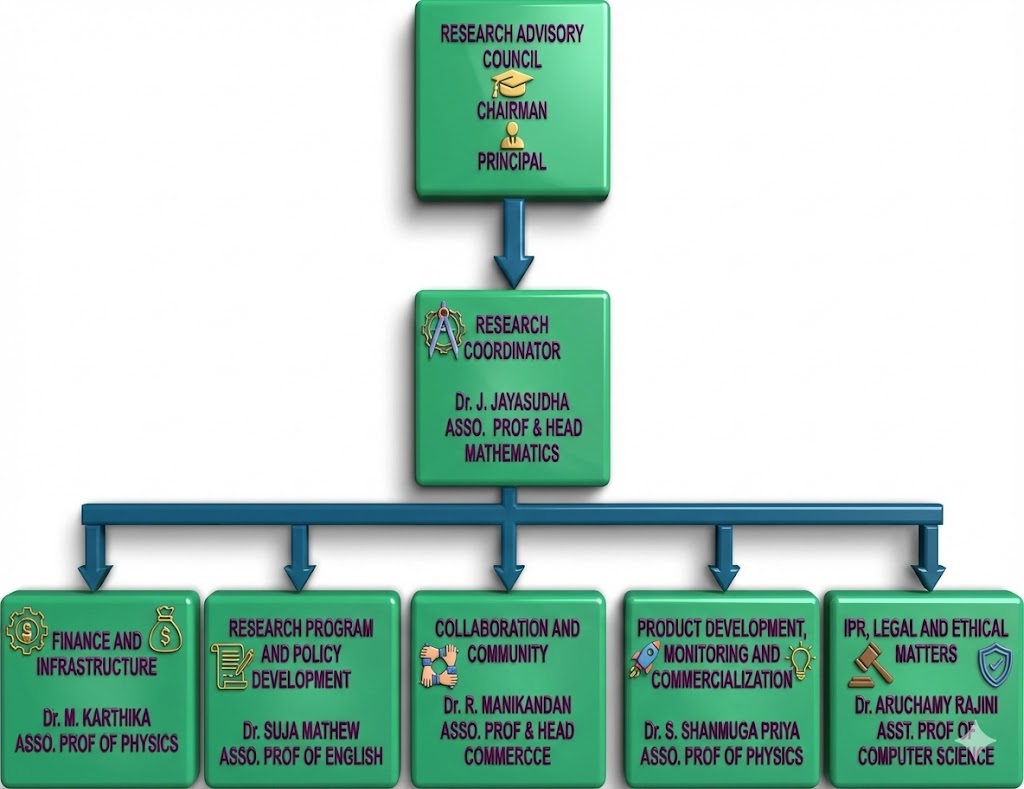
4. Organizational Structure
5. Research Contributions (2018–2025)
A summary of the institution’s scholarly output and grant mobilization:
| S.No. | Year | Journal Publications(SCOPUS/WoS/UGC) | Grants/Fellowships(In Lakhs) | Books Published | Book Chapters |
| 1 | 2018-2019 | 143 | 1.28 | 6 | 76 |
| 2 | 2019-2020 | 132 | 2.20 | 5 | 81 |
| 3 | 2020-2021 | 134 | 6.50 | 5 | 75 |
| 4 | 2021-2022 | 148 | 10.07 | 26 | 330 |
| 5 | 2022-2023 | 212 | 21.695 | 22 | 507 |
| 6 | 2023-2024 | 277 | 15.555 | 59 | 308 |
| 7 | 2024-2025 | 381 | 5.60 | 98 | 407 |
| Total | — | 1,427 | 62.90 | 221 | 1,784 |
Based on your confirmation, I have generated a Trend Analysis Report focusing on the growth patterns observed in the Research Contributions table from 2018 to 2025.
This analysis highlights the significant upward trajectory in publications and scholarly output.
📈 Research Growth Analysis Report (2018–2025)
NGM College – Research & Development Cell
1. Executive Summary
Over the past seven years, NGM College has witnessed exponential growth in scholarly output. The data indicates a strategic shift starting in the academic year 2021-2022, where key metrics (publications, book chapters, and books) saw a drastic increase, likely due to the successful implementation of the RDC’s promotional policies.
2. Key Performance Indicators (KPI) Analysis
| Metric | 2018 Baseline | 2025 Current | Growth Trend | Status |
| Journal Publications | 143 | 381 | ^ 166% Increase | 🟢 Excellent |
| Books Published | 6 | 98 | ^ 1,533% Increase | 🟢 Exceptional |
| Book Chapters | 76 | 407 | ^ 435% Increase | 🟢 Excellent |
| Grants Received | 1.28 L | 5.6 L* | Fluctuating (Peak: 21.7L) | 🟡 Needs Attention |
*Note: While grants have increased from the baseline, there is a dip in the current year compared to the 2022-23 peak.
3. Detailed Trend Observations
A. Scholarly Publications (SCOPUS/WoS/UGC)
The institution maintained a steady output of ~130-140 papers until 2021.
-
The Tipping Point: In 2022-2023, publications jumped to 212.
-
Current Momentum: The current year (2024-25) shows a record high of 381 publications, suggesting that the RDC’s incentives for high-impact journals are yielding results.
B. Book & Chapter Publications
This area has seen the most aggressive growth.
-
Explosion of Content: From publishing only 6 books in 2018, the faculty published 98 books in 2024-25.
-
Content Volume: Book chapters spiked massively in 2021-22 (330 chapters) and 2022-23 (507 chapters), indicating a shift towards collaborative authorship and edited volumes.
C. Grants & Funding
-
Peak Performance: Funding mobilization peaked in 2022-2023 with 21.695 Lakhs.
-
Current Cycle: The 2024-2025 figure stands at 5.6 Lakhs. This may indicate either a gap in proposal submissions or that major grants are currently in the evaluation phase/pipeline.
RDC Internal Seed Grant Application
Policy Guidelines: RDC Internal Seed Grant Scheme
4. Strategic Recommendations based on Data
-
Sustain Publication Momentum: The current surge in publications is excellent. The RDC should now focus on Citation Analysis (Quality over Quantity) to ensure these 381 papers are being cited globally.
-
Revitalize Grant Proposals: With a drop from the 21L peak to 5.6L, the RDC should organize a targeted “Grant Writing Boot Camp” (as mentioned in the functions) to bring funding back to 2022 levels.
-
Leverage Book Success: The massive number of books (98) and chapters (407) suggests strong domain expertise. The RDC could consolidate this by launching an in-house peer-reviewed journal or an institutional press series.
💰 Strategic Roadmap: Research Funding Revitalization (2025–2026)
Objective: To restore and exceed annual grant mobilization to >₹25 Lakhs by the end of the academic year.
1. Diagnosis & Targeted Action
The data shows a “boom and bust” cycle. To stabilize funding, we must move from sporadic individual efforts to a systematic institutional approach.
| Focus Area | Strategic Intervention |
| 📉 The Gap | Analysis of Rejections: Collect rejected proposals from 2023–2024. The RDC Review Committee should analyze why they were rejected (e.g., technical weakness, budget issues, lack of preliminary data). |
| 🎯 The Fix | “Write-Shop” vs. Workshop: Move beyond general lectures. Implement “Write-Shops” where faculty bring a draft and leave with a polished proposal. |
2. Four-Pillar Action Plan
Pillar A: Internal Mentorship (The “Train the Trainer” Model)
Leverage the faculty members who secured the ₹21.69 Lakhs in 2022–23.
-
Action: Create a “Grant Mentors Group.”
-
Method: Pair successful grantees with early-career researchers.
-
Goal: Each mentor assists in reviewing at least 2 proposals per semester.
Pillar B: Diversification of Funding Sources
Reducing reliance on standard government agencies (UGC/ICSSR).
-
Industry CSR Funds: Target local industries for Corporate Social Responsibility (CSR) funds focused on education and skill development.
-
Consultancy: Convert the high volume of book chapters (407) into training manuals for industry, generating internal revenue.
Pillar C: Seed Money & Pilot Studies
Funding agencies often reject proposals due to a “lack of preliminary results.”
-
Action: RDC to allocate small internal “Seed Grants” (e.g., ₹10k–₹20k).
-
Requirement: Recipients must use the data generated to apply for a major external grant (DST, DBT, ICSSR) within 12 months.
Pillar D: Incentivizing Submissions
Often, fear of rejection stops faculty from applying.
-
Action: Recognize “Best Proposal Submission” even if it doesn’t win funding.
-
Policy: Account for grant effort in annual appraisals, not just grant success.
3. Implementation Matrix (Q1 – Q2)
| Timeline | Action Item | Responsibility | Key Outcome |
| Month 1 | Funding Landscape Mapping | RDC Coordinators | A curated list of open calls (Govt & Private) relevant to NGM departments. |
| Month 2 | Proposal Boot Camp | External Experts | 10 Draft proposals ready for submission. |
| Month 3 | Industry Linkage Drive | Collaboration Comm. | 3 MoUs signed with specific clauses for sponsored research. |
| Month 4 | Internal Review Cycle | Review Committee | Pre-submission audit of all proposals to ensure compliance and quality. |
4. Target Metrics (KPIs)
To ensure the strategy works, track these specific numbers:
-
Submission Rate: Minimum 15 major proposals submitted per year.
-
Collaboration Rate: Minimum 3 joint proposals with other universities or industries.
-
Conversion Rate: Target a 20% success rate (Industry standard is ~10-15%).