

PG Department of Chemistry – SF
- 4Faculty Members
- 1Programme
About the Department
PG Department of Chemistry was established in 2015. The aim of our department is to promote quality education by motivating the practical skills, update knowledge, creativity and progressive research environment to meet the demands of various research institutes and industries. The curriculum has been designed and taught by active, energetic faculty members to impart knowledge and guide the student scientists. The department laboratories are well equipped and furnished with modern instruments necessary for the students to carry out their experiments and research. Our prominent research fields are Nano Material Synthesis, Phytochemistry, Synthesis of Coordination complexes, Organic Synthesis, Environmental Chemistry and biological activities like Antioxidant and acetyl cholinesterase studies etc,. All the faculties are actively involved in academic and research activities. The students are encouraged to take internships/training in reputed industries. The department also avail extension activities for the students in Food adulteration, Handmade Soap making, Standardization of herbal drugs, Herbal tooth powder, Herbal washing powder etc.,
Laboratory facilities
- Laboratory is modernized with tiles
- Marble laid working table
- RO water plant
The modern instruments / equipment’s
- Flame Photometer
- Digital Balance
- Distillation Unit
- Spectrophotometer
- Spectro flurometer
- Orbit shaker
- Soxhlet apparatus
- Rotary vacuum evaporator
- Clevenger apparatus
- Heating mantle
- Melting point Apparatus
- Potentiometer
- Conductivity meter
- pH meter
- Colorimeter
- Hot air oven
- Autoclave for nano synthesis
- Muffle furnace
- UV-Visible Spectrometer
- Lyophilizer
- Sonicator
- Microwave Oven
- Cooling Centrifuge
Learning resources
- LCD projector
- Computers with internet facility
- Departmental library
- Manuals for Practical
- Videos, PPT and Lecture notes
Vision & Mission
Vision
Mission
Impart quality education through up-to-date knowledge and information in the field of Chemistry related to science and technology and enable them to take up the challenge of the world to come.
Highlights
The department has main objective to grow continuously in terms of breadth and expertise.
The Syllabus provides an integrated and unique approach towards chemical sciences covering all branches of chemistry with choice-based credit system.
The curriculum is enriched every year to achieve international standards.
Our department organises International, National Seminars, Workshops and Conferences to create exposures for our students on latest technologies, invention in chemical sciences.
Programmes Offered
POs, PEOs & PSOs
Programme Outcomes (POs)
After completion of the M.Sc Chemistry Programme, the students must be able to
| PO1 | Disciplinary knowledge and skills: Capable of demonstrating (i) comprehensive knowledge and understanding of major concepts, theoretical principles and experimental findings in chemistry and its different subfields (analytical, inorganic, organic and physical), and other related fields of study, including broader interdisciplinary subfields such as life science, environmental science and material sciences; (ii) ability to use modern instrumentation for chemical analysis and separation. |
| PO2 | Skilled communicator: Ability to transmit complex technical information relating to chemistry in a clear and concise manner in writing and orally skills. |
|
PO3 |
Critical thinker and problem solver: Ability to employ critical thinking and efficient problem solving skills in the four basic areas of chemistry (analytical, inorganic, organic, and physical). |
|
PO4 |
Sense of inquiry: Capability for asking relevant/appropriate questions relating to issues and problems in the field of chemistry, and planning, executing and reporting the results of an experiment or investigation. |
|
PO5 |
Team player/ lifelong learners: Capable of working effectively in diverse teams in both classroom, laboratory and in industry and field-based situations as well as Capable of self-paced and self-directed learning aimed at personal development and for improving knowledge/skill development and reskilling. |
|
PO6 |
Skilled project manager: Capable of identifying/mobilizing appropriate resources required for a project, and manage a project through to completion, while observing responsible and ethical scientific conduct; and safety and chemical hygiene regulations and practices. |
|
PO7 |
Digital literacy: Capable of using computers for chemical simulation and computation and appropriate software for analysis of data, and employing modern library search tools to locate, retrieve, and evaluate chemistry-related information. |
|
PO8 |
Ethical awareness/reasoning: Avoiding unethical behaviour such as fabrication, falsification or misrepresentation of data or committing plagiarism, and appreciate environmental and sustainability issues. |
Programme Educational Objectives (PEOs)
| PEO1 | Mastering in concepts and problem solving: To understand major concepts, theoretical principles, experimental findings and the ability to employ them for critical thinking and efficient problem solving skills in different areas of Chemistry. |
|
PEO2 |
Fostering Academic Ambitions: Be motivated to prepare the students to pursue higher studies and research to meet out academic demands of the country. |
|
PEO3 |
Exploring Chemistry Techniques: Proficient in diverse chemistry techniques and their applications in scientific and engineering contexts. |
|
PEO4 |
Stimulating Student Writing: Students will be stimulated to interchange their knowledge and skills for developing independent writing in their field of study. |
|
PEO5 |
Empowering Responsible Graduates: Graduates will contribute to the growth of the nation and society as ethical and responsible professionals. |
Programme Specific Outcomes (PSOs)
After completion of the M.Sc Chemistry Programme, the students must be able to
|
PSO – 01 |
Inter-Disciplinary knowledge:Become Proficient in synthetic, analytical, electrochemistry, Phytochemistry, spectral techniques, characterization to develop interdisciplinary approach. |
|
PSO – 02 |
Innovative Thinking:Develop new innovations in chemical, pharmaceutical and allied chemical industries and successfully implement them at an industrial scale. |
Faculty
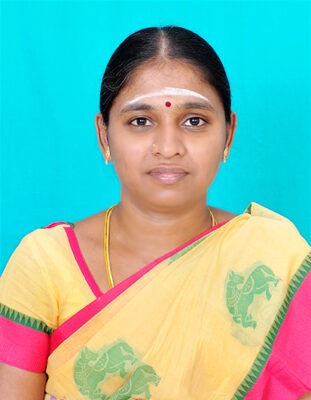
Dr. N. Neelakandeswari
Assistant Professor
M.Sc., M.Phil., Ph.D., PGDNSNT
Specialisation: Inorganic Nanomaterials, Sensors, Solar cells and Heterogenious Catalysis
Experience: Indusrtry - 2.2, Research - 3 & Teaching - 15


Dr. M. Velayutham Pillai
Assistant Professor
M.Sc.,M.Phil.,Ph.D., D. Astro.
Specialisation: Organic Synthesis; Spectroscopy; Crystallography; Computational Chemistry: Stereochemistry
Experience: Teaching - 14; Industry - 2; Full Time Reseach - 5

No faculty match your search.
Clubs & Associations
“CHEMergence – When you get here, you flourish”
CHEMergence is an association which inculcates in upbringing the department and also setting up new ideas for the moral and intellectual growth of students.
The motto of CHEMergence is to promote the interaction between the chemistry students with the hope of developing passion for the subject through the activities like seminar, workshop, discussion, quiz, exhibition etc., the association gives a platform for the students to get involved in the activities which will instill deep interest in the subject through the involvement in association activities.
Office bearers (2023-2024)
President : Mr. S. Mukilan II-M.Sc Chemistry
Vice President : Mr. S. Namith Nath I- M.Sc Chemistry
Secretary : Mr. S. Vishnuvardhan II- M.Sc Chemistry
Vice secretary : Ms. S. Thamarishri I- M.Sc Chemistry
Photo Gallery