
NGM College
1. Introduction & Vision
| Component | Description |
| Identity | The central body responsible for fostering a robust research culture among faculty and students. |
| Vision | To transform the institution into a Centre of Excellence by encouraging innovative thinking, scholarly publications, and industry-sponsored projects. |
| Mission | To bridge the gap between theoretical knowledge and practical application, providing infrastructure and administrative support to facilitate high-quality research. |
2. Strategic Objectives
The primary goals of the RDC are categorized below:
| Symbol | Objective Category | Description |
| 🧬 | Culture | Promote an inclusive, interdisciplinary, and socially relevant research culture aligned with national priorities. |
| 📜 | Policy | Formulate and implement research policies in accordance with UGC regulations, ethical standards, and funding agency norms. |
| 💰 | Funding | Assist faculty in identifying funding opportunities and resource mobilization from national and international agencies. |
| 🤝 | Collaboration | Foster linkages with industries, government agencies, and research organizations to promote innovation and consultancy. |
| 🧠 | Capacity Building | Enhance competence through FDPs, workshops, and mentoring on methodology, IPR, and emerging tools. |
| 📢 | Visibility | Encourage dissemination through high-impact publications, patents, copyrights, and conference participation. |
| 🗃️ | Documentation | Maintain a Research Information Management System (RIMS) for systematic analysis and reporting of scholarly outputs. |
3. Functions of the RDC
The operational responsibilities of the cell are divided into seven key domains:
| Domain | Key Responsibilities |
| ⚙️ Administration | Establish organizational structures and committees for effective planning. Enforce policies for the optimal utilization of infrastructure. Periodically review RDC activities through constituted committees. |
| 🚀 Promotion & Capacity | Mentor researchers in proposal development, patent filing, and technology transfer. Organize workshops, colloquia, and training on advanced digital tools. Support early-career researchers via orientation and progress reviews. Encourage publications in SCI/SCOPUS/WoS indexed journals. |
| 🌐 Ecosystem & Collaboration | Promote interdisciplinary and transdisciplinary research. Facilitate MoUs, joint projects, and student exchanges. Bridge the gap between academia and industry for real-world applicability. |
| 💻 Info Management (RIMS) | Maintain a centralized system for data collection (projects, grants, patents). Ensure transparent access to validated and reliable research data. Capture comprehensive profiles of researchers and facilities. |
| 👥 Human Resources | Develop policies for the recruitment and retention of research personnel (Post-docs, Fellows). Ensure effective deployment of HR to strengthen the innovation ecosystem. |
| ⚖️ Integrity & Ethics | Uphold the highest standards of academic honesty and plagiarism prevention. Ensure compliance with national/international ethical guidelines. Facilitate the Institutional Ethics Committee. |
| 📊 Research Monitoring | Track progress of funded programs and ongoing projects. Periodically review outcomes against institutional benchmarks. Identify gaps/risks and recommend corrective measures. |
4. Organizational Structure
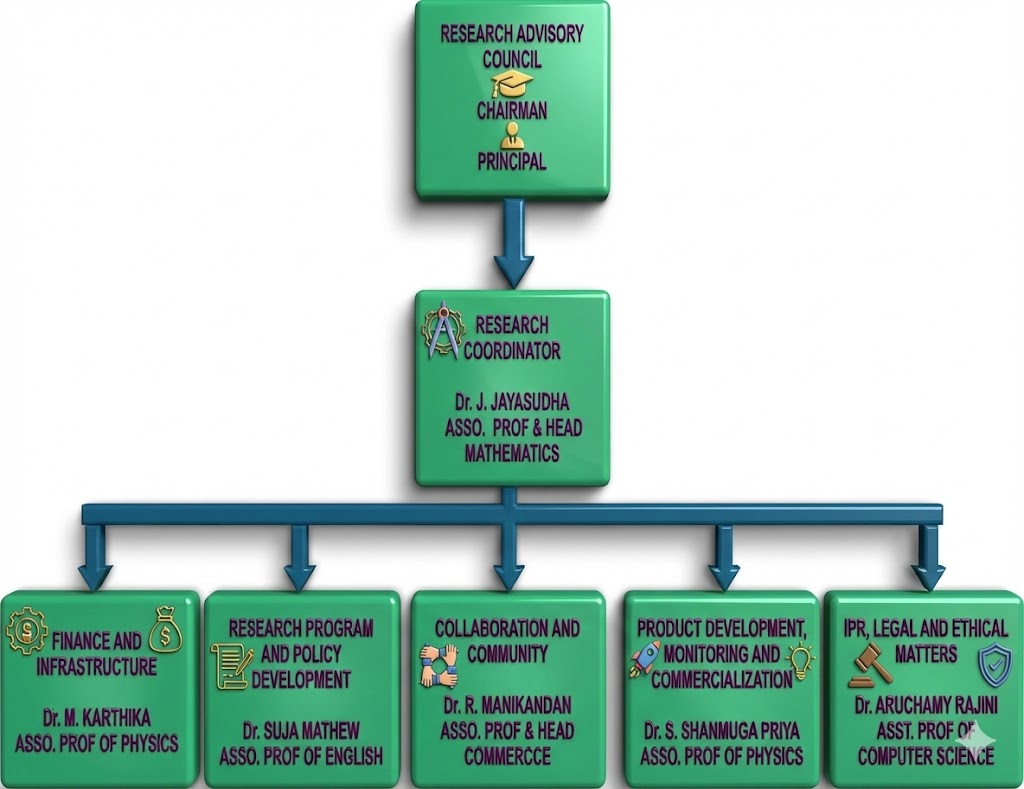
Principal / Head of Institution↓Dean / Coordinator (RDC)↓Advisory CommitteeEthics CommitteeReview Committee↓Faculty & Student Researchers
5. Research Contributions (2018–2025)
A summary of the institution’s scholarly output and grant mobilization:
| S.No. | Year | Journal Publications(SCOPUS/WoS/UGC) | Grants/Fellowships(In Lakhs) | Books Published | Book Chapters |
| 1 | 2018-2019 | 143 | 1.28 | 6 | 76 |
| 2 | 2019-2020 | 132 | 2.20 | 5 | 81 |
| 3 | 2020-2021 | 134 | 6.50 | 5 | 75 |
| 4 | 2021-2022 | 148 | 10.07 | 26 | 330 |
| 5 | 2022-2023 | 212 | 21.695 | 22 | 507 |
| 6 | 2023-2024 | 277 | 15.555 | 59 | 308 |
| 7 | 2024-2025 | 381 | 5.60 | 98 | 407 |
| Total | — | 1,427 | 62.90 | 221 | 1,784 |
Based on your confirmation, I have generated a Trend Analysis Report focusing on the growth patterns observed in the Research Contributions table from 2018 to 2025.
This analysis highlights the significant upward trajectory in publications and scholarly output.
NGM College – Research & Development Cell
1. Executive Summary
Over the past seven years, NGM College has witnessed exponential growth in scholarly output. The data indicates a strategic shift starting in the academic year 2021-2022, where key metrics (publications, book chapters, and books) saw a drastic increase, likely due to the successful implementation of the RDC’s promotional policies.
2. Key Performance Indicators (KPI) Analysis
| Metric | 2018 Baseline | 2025 Current | Growth Trend | Status |
| Journal Publications | 143 | 381 | ^ 166% Increase | 🟢 Excellent |
| Books Published | 6 | 98 | ^ 1,533% Increase | 🟢 Exceptional |
| Book Chapters | 76 | 407 | ^ 435% Increase | 🟢 Excellent |
| Grants Received | 1.28 L | 5.6 L* | Fluctuating (Peak: 21.7L) | 🟡 Needs Attention |
*Note: While grants have increased from the baseline, there is a dip in the current year compared to the 2022-23 peak.
3. Detailed Trend Observations
A. Scholarly Publications (SCOPUS/WoS/UGC)
The institution maintained a steady output of ~130-140 papers until 2021.
- The Tipping Point: In 2022-2023, publications jumped to 212.
- Current Momentum: The current year (2024-25) shows a record high of 381 publications, suggesting that the RDC’s incentives for high-impact journals are yielding results.
$$\text{Avg. Growth Rate (last 3 years)} \approx 27\% \text{ per annum}$$
B. Book & Chapter Publications
This area has seen the most aggressive growth.
- Explosion of Content: From publishing only 6 books in 2018, the faculty published 98 books in 2024-25.
- Content Volume: Book chapters spiked massively in 2021-22 (330 chapters) and 2022-23 (507 chapters), indicating a shift towards collaborative authorship and edited volumes.
C. Grants & Funding
- Peak Performance: Funding mobilization peaked in 2022-2023 with 21.695 Lakhs.
- Current Cycle: The 2024-2025 figure stands at 5.6 Lakhs. This may indicate either a gap in proposal submissions or that major grants are currently in the evaluation phase/pipeline.
RDC Internal Seed Grant Application
Policy Guidelines: RDC Internal Seed Grant Scheme
4. Strategic Recommendations based on Data
- Sustain Publication Momentum: The current surge in publications is excellent. The RDC should now focus on Citation Analysis (Quality over Quantity) to ensure these 381 papers are being cited globally.
- Revitalize Grant Proposals: With a drop from the 21L peak to 5.6L, the RDC should organize a targeted “Grant Writing Boot Camp” (as mentioned in the functions) to bring funding back to 2022 levels.
- Leverage Book Success: The massive number of books (98) and chapters (407) suggests strong domain expertise. The RDC could consolidate this by launching an in-house peer-reviewed journal or an institutional press series.
Objective: To restore and exceed annual grant mobilization to >₹25 Lakhs by the end of the academic year.
1. Diagnosis & Targeted Action
The data shows a “boom and bust” cycle. To stabilize funding, we must move from sporadic individual efforts to a systematic institutional approach.
| Focus Area | Strategic Intervention |
| 📉 The Gap | Analysis of Rejections: Collect rejected proposals from 2023–2024. The RDC Review Committee should analyze why they were rejected (e.g., technical weakness, budget issues, lack of preliminary data). |
| 🎯 The Fix | “Write-Shop” vs. Workshop: Move beyond general lectures. Implement “Write-Shops” where faculty bring a draft and leave with a polished proposal. |
2. Four-Pillar Action Plan
Pillar A: Internal Mentorship (The “Train the Trainer” Model)
Leverage the faculty members who secured the ₹21.69 Lakhs in 2022–23.
- Action: Create a “Grant Mentors Group.”
- Method: Pair successful grantees with early-career researchers.
- Goal: Each mentor assists in reviewing at least 2 proposals per semester.
Pillar B: Diversification of Funding Sources
Reducing reliance on standard government agencies (UGC/ICSSR).
- Industry CSR Funds: Target local industries for Corporate Social Responsibility (CSR) funds focused on education and skill development.
- Consultancy: Convert the high volume of book chapters (407) into training manuals for industry, generating internal revenue.
Pillar C: Seed Money & Pilot Studies
Funding agencies often reject proposals due to a “lack of preliminary results.”
- Action: RDC to allocate small internal “Seed Grants” (e.g., ₹10k–₹20k).
- Requirement: Recipients must use the data generated to apply for a major external grant (DST, DBT, ICSSR) within 12 months.
Pillar D: Incentivizing Submissions
Often, fear of rejection stops faculty from applying.
- Action: Recognize “Best Proposal Submission” even if it doesn’t win funding.
- Policy: Account for grant effort in annual appraisals, not just grant success.
3. Implementation Matrix (Q1 – Q2)
| Timeline | Action Item | Responsibility | Key Outcome |
| Month 1 | Funding Landscape Mapping | RDC Coordinators | A curated list of open calls (Govt & Private) relevant to NGM departments. |
| Month 2 | Proposal Boot Camp | External Experts | 10 Draft proposals ready for submission. |
| Month 3 | Industry Linkage Drive | Collaboration Comm. | 3 MoUs signed with specific clauses for sponsored research. |
| Month 4 | Internal Review Cycle | Review Committee | Pre-submission audit of all proposals to ensure compliance and quality. |
4. Target Metrics (KPIs)
To ensure the strategy works, track these specific numbers:
- Submission Rate: Minimum 15 major proposals submitted per year.
- Collaboration Rate: Minimum 3 joint proposals with other universities or industries.
- Conversion Rate: Target a 20% success rate (Industry standard is ~10-15%).